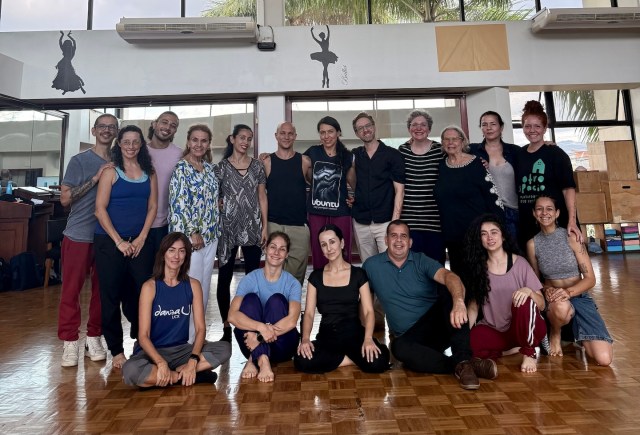

On a July afternoon, I walked into a dance studio on the second floor of the Centro de Artes Promenade and felt very much at home. Dancers were sprawled on the floor stretching, and there was a series of shelves for shoes and personal belongings. No one needed to remind me to take off my shoes. It had taken Alvaro (my favorite driver and friend) and I over an hour and a half to get to the studio, as it is located on the eastern side of San Jose, and Atenas is on the western side of San Jose. We had hit a major traffic jam on the way to the Center, but Alvaro had gotten off the main road and with the help of Waze found side roads to avoid the traffic. We made it with a few minutes to spare.
The building is quite lovely and is described as “a place to create, work and flow without stress.” As Alvaro and I entered the building we saw a cafeteria to our left and soon were greeted warmly by Ashley Lucas, Vicente Concilio, Caroline Vetori and Ana Celia Zentella. We easily recognized each other from a Zoom meeting. I was joining them for two days of workshops, and then a few days later Ashley, Vicente, and Caroline would come to Casa Uno for the only three-week residency I scheduled for 2026.
I had reached out to Ashley, who is a Professor at the University of Michigan. She had come up in a Google search for people who did arts programs in prisons. When she wrote about the project she was doing with two colleagues from Brazil, I was fascinated and decided that this was a residency I wanted to welcome to Casa Uno. I loved the idea that they were involved in both writing and theatre programs in prisons and had worked in such settings for many years.
Ashley is a scholar of the arts in prisons, having personally visited 15 countries and seen programs in action. She has written a book that I look forward to reading called Prison Theatre and the Global Crisis of Incarceration. The University of Michigan has a Prison Creative Arts Project (PCAP) which includes a journal that showcases the talent and diversity of writers incarcerated in Michigan, and an annual art exhibit. Students are trained to lead theatre and writing workshops in Michigan’s prisons.
Once the residency at Casa Uno was confirmed, Ashley went to work figuring out how to do a workshop in a prison in Costa Rica when she, Caroline, Ana Celia, and Vicente were here. Through Ana Celia, who had been in the Peace Corps years ago in Costa Rica and still had contacts here, she was able to arrange a workshop in a small men’s prison. In addition, a contact from the University of Michigan put her in touch with Mario Vircha, who is the director of a dance company connected with the University of Costa Rica. Ashley arranged for us to do a workshop with two professional contemporary dance companies to introduce them to her team’s work. Mario and two other dancers would join us the next day for the workshop in prison.
Ashley invited me to share the work I did with The Avodah Dance Ensemble in prisons as part of the workshop. (For an example of Avodah’s work in prisons see this blog.) I spent two weeks planning what I would say in the 15 minutes I was assigned. I chose my words carefully, since I would be speaking in English and then Ana Celia would translate into Spanish. Ashley said she, Vicente and Caroline would lead us in a movement/improv workshop such as they might lead in their prison work. Then we would speak about our work in the prisons. I would go first.
I asked Alvaro if he would like to join us in the dance studio and photograph the session using my cell phone, and I am very grateful to Alvaro for the series of photos that I can now share.
The 20 dancers in the room were from two different dance companies. Each company was composed of 10 dancers, who are paid a full-time year-round salary approved and paid by the government. That was surprising news for me, and I hope to interview one of the dancers or company directors for a future blog.
Once everyone had gathered in the spacious studio, we made a large circle and the workshop began with Caroline leading us to say our name with a movement. That was fun and an activity I had used at a labyrinth workshop I led at my home a few weeks before. Next Vicente asked us to find a partner. One partner led with their hand while the other partner had to keep their eyes on the hand and follow, letting the movement develop. That was a new movement improvisation for me and was fun to do. I was delighted my dance partner considered my range of movement and made it easy for me to follow her.

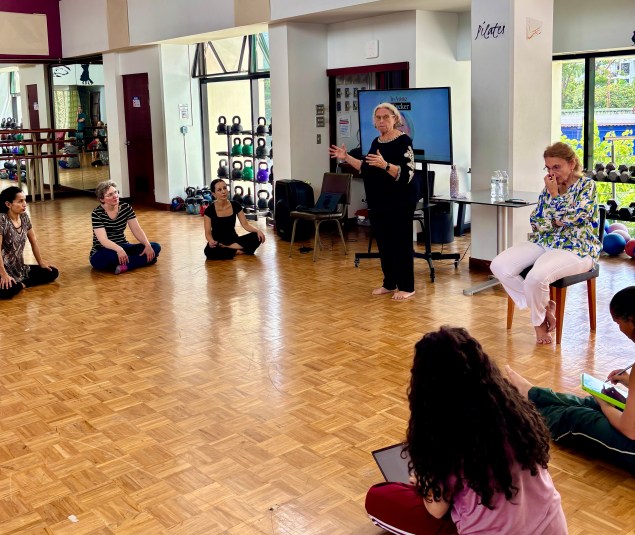
Ashley led with a more complicated circle game with key words like “woosh” and “woo,” which stopped and started flow of movement, and that was a bit tricky for me. Building sculptures was fun to do and again something I was familiar with. The bottom line was, if I knew the activity it was easy for me to follow the instructions in Spanish but when an exercise was entirely new, it was harder and sometimes I had to ask for a few key words in English, which were happily supplied. Following the movement activities we all gathered around a large TV that had been set up so we could talk about our work and show slides.
While I stumbled at first in speaking, I quickly got in the flow of speaking and pausing for Ana Celia to translate for me. Soon I was finished and Ana Celia spoke of her work, followed by Ashley, Vicente and Caroline. The dancers were attentive, and excellent questions followed. It was clear working in prisons was new to them, and it seemed we piqued some interest for following through with some work in Costa Rican prisons.
The day concluded with some refreshments and socializing. The mood was very welcoming and warm. I was delighted to have learned more about the contemporary dance scene in Costa Rica and to have had the opportunity to be part of the workshop, both as a participant and as a presenter. And most of all it felt quite wonderful to be in a dance studio around dancers. I have missed that.